


Recently, an academic paper titled “Dynamic Response and Deformation Characteristics of a Hyperelastic Sphere during Water Entry”, completed by Feng Zhizhong—an undergraduate student of the 2022 cohort majoring in Naval Architecture and Ocean Engineering at the JEI—as the first author, was officially published online in the authoritative journal Scientia Sinica Physica, Mechanica & Astronomica. This paper represents the core output of his undergraduate graduation thesis, with Prof. Xiong Chengwang from the College of Shipbuilding Engineering serving as his Chinese academic supervisor.
According to the Harbin Engineering University Journal Grading and Classification Directory (2023 Edition), this journal is classified as a top Category A publication in our university’s journal ranking directory. Sponsored by CAS, its English edition is indexed in the ESCI and Scopus databases, while its Chinese edition is recognized as a CSCD core journal and a Peking University Core Chinese Journal. It serves as a benchmark comprehensive academic publication in the fields of physics, mechanics, and ocean engineering in China, with a leading academic influence domestically.
The paper focuses on the dynamic response and deformation characteristics of a hyperelastic sphere during water entry, conducting a systematic study on the nonlinear impact mechanics of hyperelastic materials under high-speed water entry conditions. The research fully establishes a numerical analysis method for the entire process of hyperelastic structure water entry, accurately characterizes the large deformation evolution laws driven by fluid-structure interaction after the sphere enters the water, and clarifies the mechanisms by which material elastic parameters and water entry velocity influence impact loads and structural deformation. The relevant research conclusions can be applied to the engineering design of underwater vehicles and marine buffering and protective equipment, providing theoretical references for the shock-resistance optimization of naval and marine equipment.
This research was conducted based on his undergraduate graduation project and was completed under the comprehensive guidance of Prof. Xiong Chengwang. As the first Sino-British cooperatively-run educational institution characterized by naval architecture and ocean engineering approved by the Ministry of Education, the JEI implements a dual-supervisor system for undergraduate graduation projects, featuring joint guidance from both Chinese and Britishsupervisors. This system brings together high-quality faculty from both universities to provide process-oriented guidance in academic norms, research methods, and academic writing. From the selection of the research topic and the construction of the technical route to the drafting and polishing of the manuscript, Prof. Xiong provided meticulous professional guidance. During his university years, Feng Zhizhong focused fluid mechanics and impact dynamics. Centered around his graduation project, he consistently tracked frontier trends in ship water-entry impact, utilized his extracurricular time to complete extensive numerical simulations and model data analyses, and dedicated himself to overcoming research challenges related to nonlinear material deformation. Ultimately, he successfully distilled his graduation thesis findings into a high-quality original academic paper for publication.
Relying on the university’s advantageous disciplinary resources, the JEI has established a complete educational pathway integrating “classroom theory — scientific research practice — academic output,” guiding students to transform professional knowledge into practical, publishable innovative achievements. Closely aligning with the strategic needs of building a strong maritime nation, the JEI adheres to the educational principle of consolidating engineering foundations and strengthening innovative practices. By tailoring teaching to individual aptitudes to tap into students’ research potential, the JEI encourages undergraduates to engage in scientific research and participate in cutting-edge projects early on, striving to cultivate young scholars with solid scientific research literacy and innovative capabilities. Feng Zhizhong’s diligent and proactive approach to scientific research has set an excellent example for all students in the Institute. Moving forward, the JEI will continue to refine its scientific and technological innovation education mechanisms, build higher-level academic practice platforms, and cultivate more young talents who are dedicated to the maritime cause and courageous enough to shoulder the mission of scientific research and innovation.
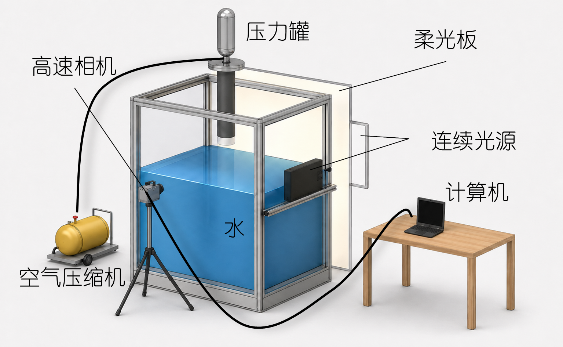
Experimental Setup
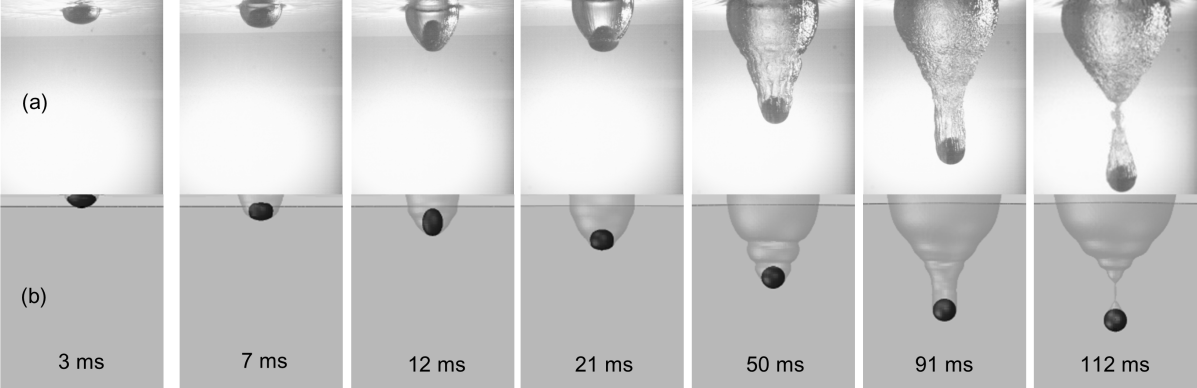
Figure 8 Deformation and cavity evolution of hyperelastic sphere (Material 2) when it enters water vertically at 15 m/s: (a) High-speed photography experiment; (b) CEL numerical simulation.
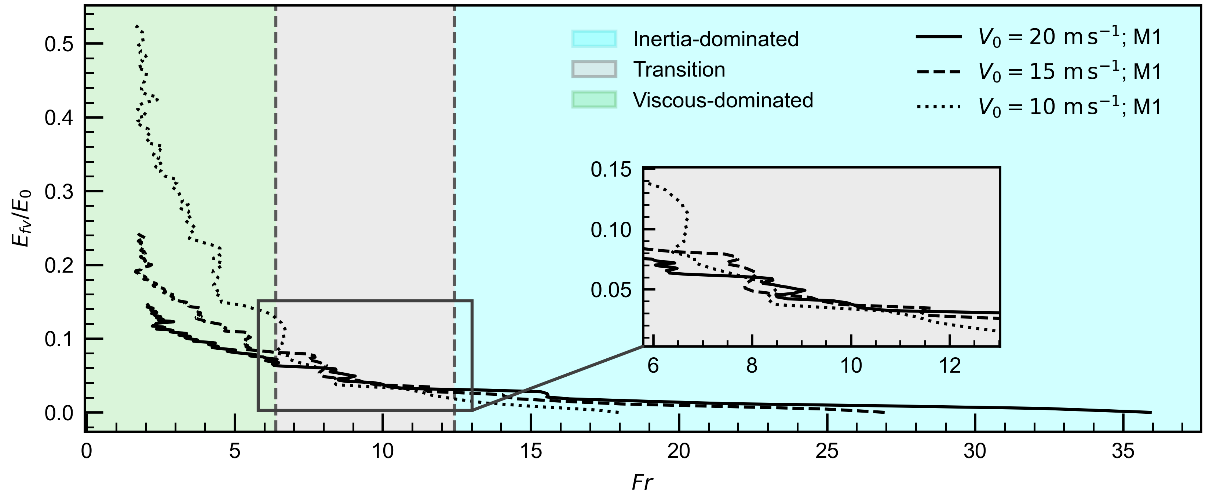 Figure 19 Dimensionless viscous dissipation energy in the fluid domain as a function of the instantaneous Froude number for Material 1 spheres at different water-entry velocities. The inset magnifies the curves in the transition regime.
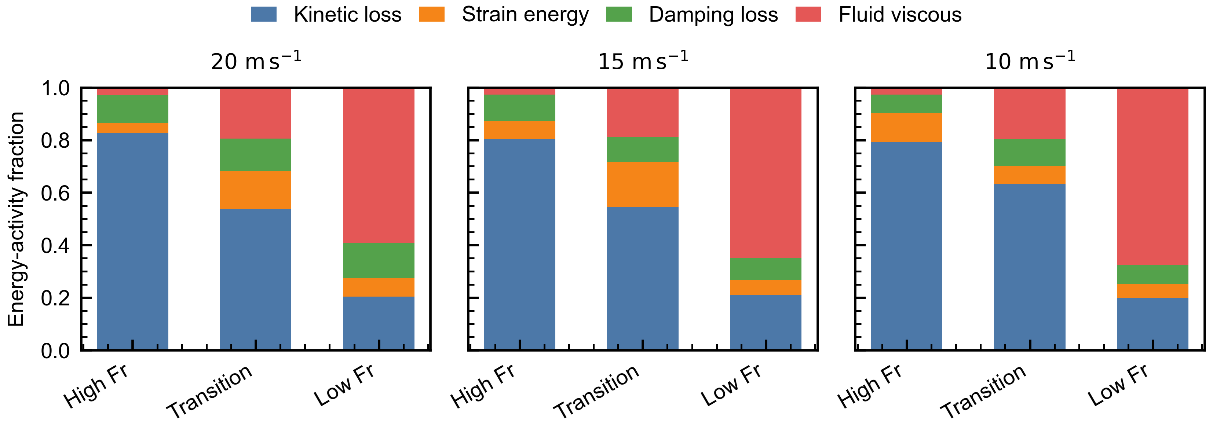
Figure 20 Fractions of energy-budget terms in different stages defined by the instantaneous Froude number for Material 1 spheres under three water-entry velocity conditions.
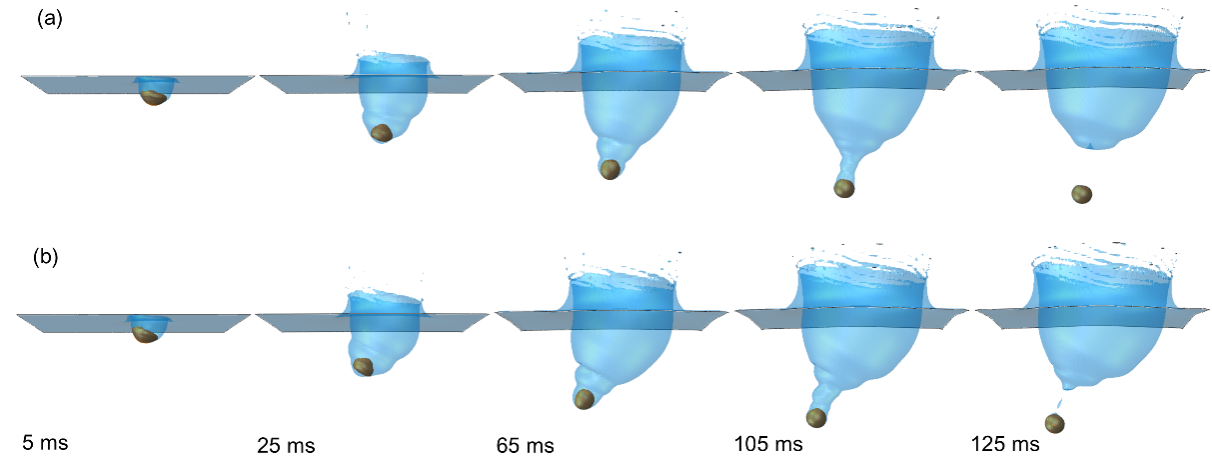
Figure 23 Evolution of the cavity of sphere under different water entry angles: (a) 80° (b) 70°.